
Chemistry Electrodes
We manufacture/ supply a wide range of electrodes for measuring water quality.These electrodes connect to either the WP4007 multichannel datalogger, the 520c Chemistry and Water quality monitor or the Multiparameter 803PS Sonde.
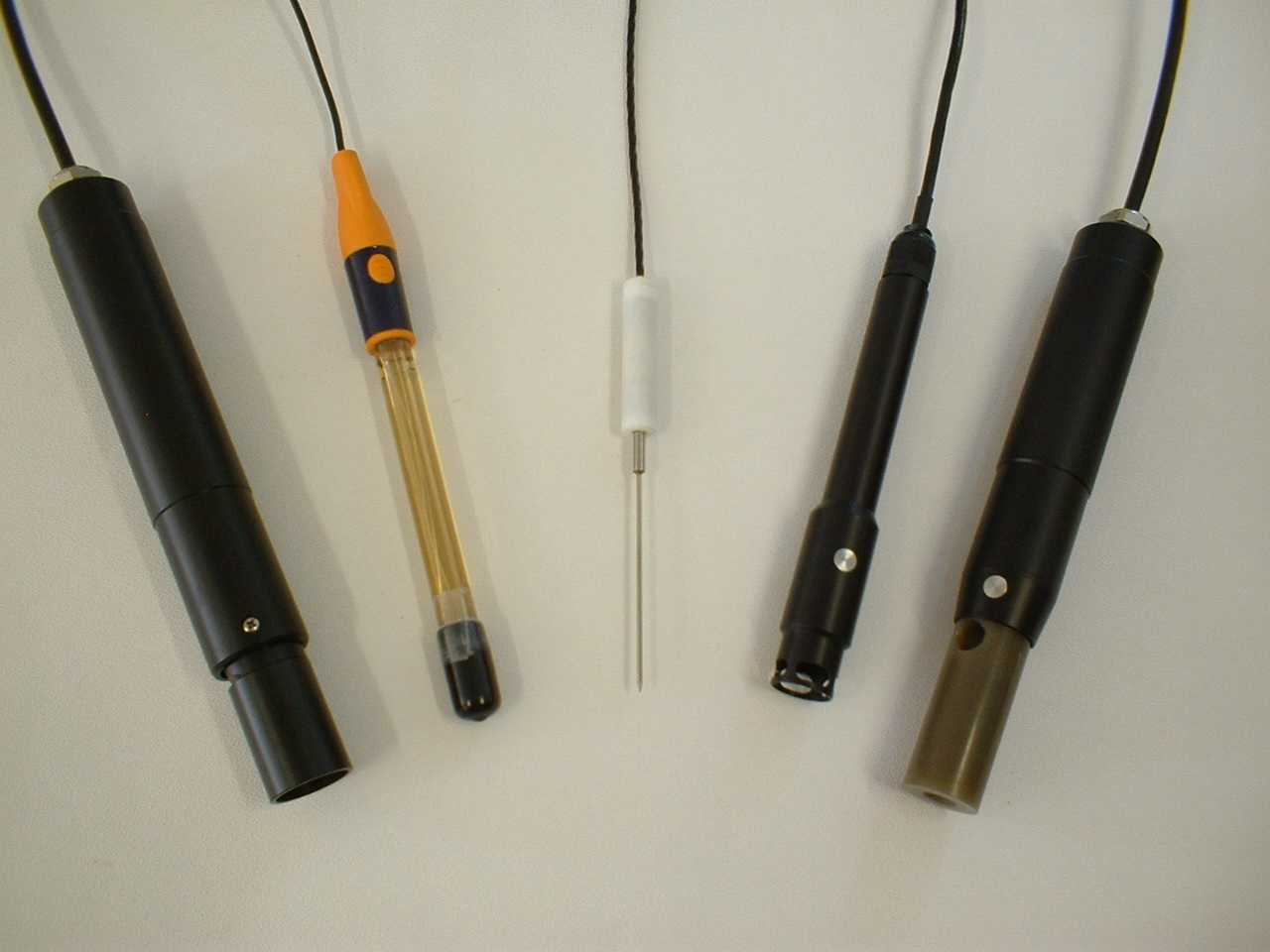
We recommend a simple 4-step procedure to collect and analize consistently accurate data:
Step 1: Electrode maintenance
Step 2: Intial calibration
Step 3: Field measurement
Step 4: Post calibration Check
Note:
Always start with clean and properly maintained electrodes, then carry out your field measurements. Once you are finished, then check your calibration.
Using in the Field
When transporting the instrument and electrodes remember three things:
1. Do not let the electrodes dry out
2. Avoid extreme temperatures
3. Avoide vibration and shock
Making Measurements
After you have calibrated the instrument and electrodes, you are now ready to take measurements in the field.
1. Remove the electrode protective cover.
2. Plug the electrode connector into the correct instrument socket.
3. Press the ON key and select the correct channel.
4. Dip the electrode into the water to be checked.
5. After you have finished it will be necessary to verify calibration. Check each parameter for post-calibration, using the appropriate standards.
6. If the electrode is contaminated with silt, greases or oils then perform a quick clean-up, following specific cleaning instructions for each electrode.
7. Having checked that the electrodes are clean, replace the electrode protective covers on the electrodes and store away.
Note
During field measurements you must avoid "thermal insabilty", since all chemical measurements change with temperature. The instrument assumes that the electrodes are at the same temperature as the Pt100 temperature sensor, but if that equilibrium condition is not true, then the displayed value may include temperature errors.
Thermal equilibrium is always lost for a short time whenever an electrode is put into a new environment (for example from air into a river). If you are not sure whether the electrode is stable then first measure, wait 3 minutes, then recheck. If the second reading is the same as the first, then the electrode was stable at the first check.
The WP4007 allows you to use your own ("OEM") sensors and transmitters as inputs. The WP4007 accepts ±800mV frequency/ event signals and a 4-20mA signal. Voltages up to ±10V can be accepted with use of the appropriate adaptor contact LMS water for details. Water flow meters can also be used.
Frequency Signals
The WP4007 can accept frequency signals, measuring either frequency, period, or time between events.
Water Flow Meters
The following electronic water flow meters are available:
2031H Standard meter, capable of detecting water flow in the range 0.1 m/s to 7.9 m/s
2031HR2 Low flow meter for measuring water flow in the range 0.02 m/s to 1.0 m/s
The low flow meter 2031HR2 is identical to the standard flow meter 2031H, except that it includes a larger propeller to detect low flow rates.
803PS Sonde (WP4007 only)
The 803PS Sonde accommodate up to eight different chemistry electrodes for measuring water quality.
The 803PS Sonde contains its own microprocessor and control electronics, so the cable from the Sonde to the WP4007 supplies only the power and digital interface between the instrument and the Sonde.
The Sonde can withstand 100 m water depth, and can be used to measure estuaries, lakes, rivers and effluent.
Electrode availability
A wide choice of compatible electrodes are available for the measurement of:
Temperature
pH
Conductivity/ Salinity/ TDS
Turbidity
Dissolved Oxygen
Selective Ion